What to Expect in Your Child’s First Month of Malayalam Classes: A Guide for US Parents
For parents raising children in the USA, introducing Malayalam at home can be a meaningful way to help them stay connected to their language and culture. At the same time, there can also be some questions floating in your head. For example, what will the first lesson be? Will my child enjoy it? Will it be challenging for them to learn a language that they don’t hear on a daily basis? It is quite understandable; however, it would be good for you to know that the first month of Malayalam classes will be more about getting used to the language than mastering all of its aspects immediately. The first month includes learning the sounds, rhythm, basic vocabulary, and phrases of the language in a relaxed environment.
It should also be noted that for many children in the US, Malayalam classes may become their first encounter with a well-structured program for studying heritage languages. That is why most of the lessons in the beginning will focus on simple greetings, singing songs, playing various games, listening to interesting stories, and other entertaining activities. All these actions are done in order to help children get familiar with the language and start enjoying speaking and listening to it. In this blog, we’ll look at what you can expect during your child’s first month of Malayalam classes and how you can support their learning at home.
Week One: Getting comfortable & not getting ahead
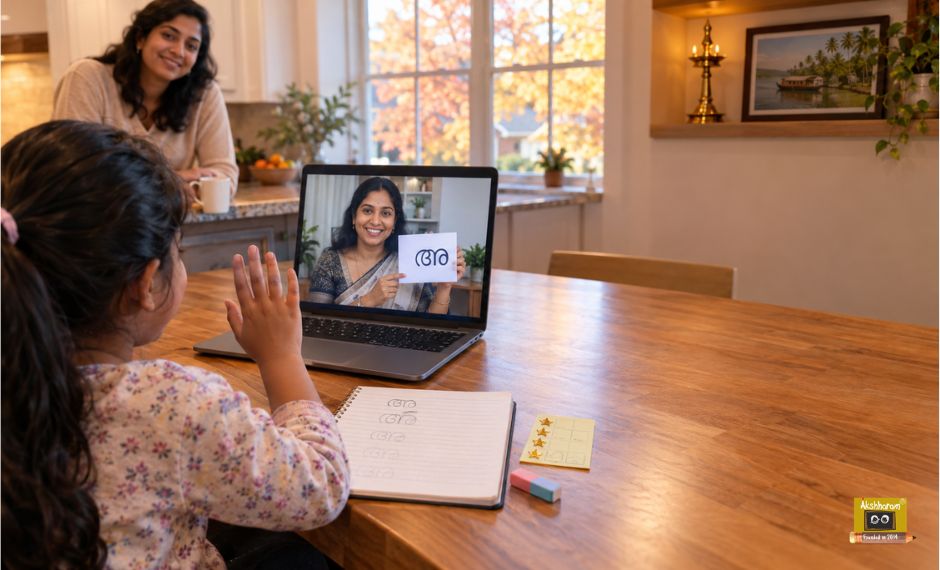
Children (especially those born in the US) are unlikely to learn much Malayalam during the first week of the course. Instead, they're shown how to learn Malayalam and to be comfortable with being taught it. This can be challenging, especially if they've been exposed to the language at an early age. They may recognize the spoken words (due to their exposure), but have never seen the written script before. The first few lessons are designed to make students feel at home; so much so that a tutor might not show progress in the alphabet or introduce them to anything more than the basics of conversation (greetings and simple rhymes). For children who learn Malayalam online, this gentle introduction can help them become comfortable with the language before moving on to reading and writing.
If you notice your child being hesitant or shy on camera, do not worry. Such feelings are normal, especially when the child has significant experience with the spoken language but little or no experience with its script.
Week Two: Recognition of a few letters
Most children (again, unless they've had significant exposure to the language) should be able to recognize a few Malayalam letters by the second week. This is usually the week where children claim that they recognize letters and words in the Malayalam script, especially while out and about or when presented with the alphabet. It is during this week that most tutors begin to practice tracing and recognition exercises (such as matching letters to pictures and simple songs). It's important to remember that practice builds recognition and confidence, but rushing the process, that is, by making the child trace letters before they develop proper recognition will ultimately prove counter-productive.
Week Three: Putting letters together
It is in the third week that most children are able to put the letters they know together to form simple, familiar words. This is a very exciting week for most parents, as it is the week where most children begin to recognize letters on their own and are able to attempt simple words (often related to food or familial relationships). For instance, if 'Amma' was a familiar word at home, they'd be able to recognize this word (and possibly attempt to read it out).
This is also the week where most children (particularly those who were very shy at first) begin to assert themselves in the class, attempt more complex letters, and even correct their siblings who may be learning Malayalam at the same time.
Week Four: A sense of accomplishment
By the end of the month, most children would have been exposed to enough letters to recognize simple words and would've developed a sense of accomplishment. Conversations will still seem intimidating and most will not have mastered the art of decoding individual letters into recognizable meanings. However, they'll develop a sense that the language is no longer alien to them.
For most NRI families, this is the part where your child looks at you and attempts to read out a Malayalam word on their own.
Why learn Malayalam this way?
If you're a parent looking to help your child learn Malayalam, the best thing you can do for them is to be patient. While it may seem like the child isn't making much progress, they usually are - just at a slower rate than the tutor might be used to. Remember, these children are learning Malayalam as a foreign language - not as their mother tongue. For children who are starting to learn Malayalam for beginners, taking small steps can make the learning process more comfortable and enjoyable. It's also important not to confuse them by exposing them to the language in other ways such as watching movies or asking them to read out random letters or words. Simple ways parents can contribute
- Speak more Malayalam at home, even if it's only to identify common objects
- Show enthusiasm and praise progress, even if it seems minimal
- Avoid making learning Malayalam a chore or an extra task. Keep lessons simple but frequent
- Let grandparents help wherever possible (via video calls or lessons). Hearing familiar voices saying words in Malayalam is a great way for young children to pick up the language
The bigger picture
A month may not seem like much, but it usually defines a child's relationship with Malayalam for the long-term. It either marks the beginning of a fruitful linguistic adventure or puts the idea of learning Malayalam far away for as long as they can remember. With patience and the right training, most children are likely to come out of the first month both excited and eager to learn more Malayalam. After all, one month of patience, gradual learning is better than a lifetime of frustration and confusion.
Why Akshharam?
Akshharam's Malayalam courses are designed with this exact philosophy in mind. By focusing on gradual, patient progress and rewarding small milestones, most children are likely to enjoy their first month of learning Malayalam.