
From Understanding to Speaking: Helping Malayali Kids in the USA Gain Confidence in Malayalam
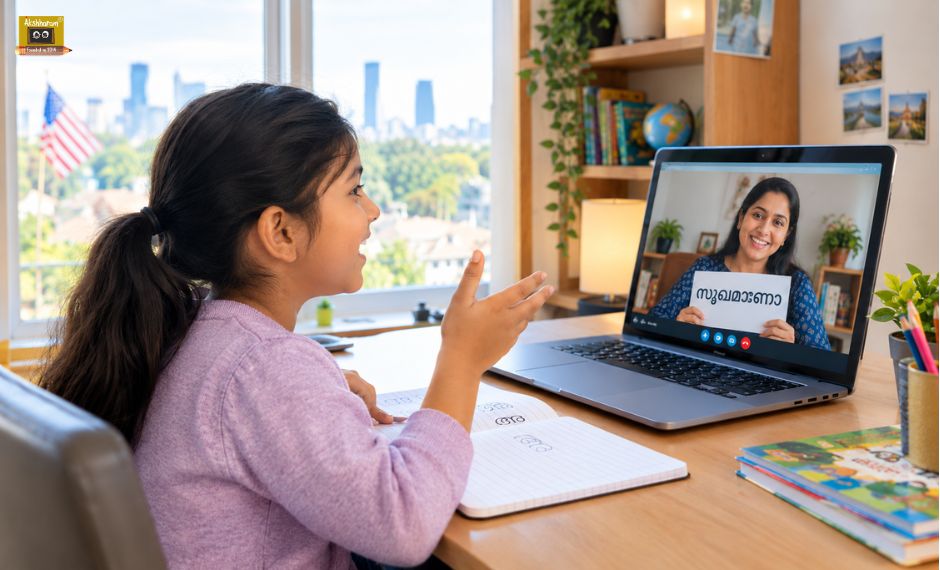
All parents from Kerala who have settled down in America would have been through this situation before, that is, your child comprehends everything you are saying in Malayalam – they giggle, they know when their mom is scolding them in a way that they love, and enjoy the Malayalam lullabies that their grandparents sing through video chats, but when coming to speaking Malayalam of their own, they fail to do so. The case is that they know the language, but can’t speak or write.
This is one of the most common problems – and also one of the most easily solved ones – for families who have moved overseas and have children from Kerala.
Why Do Kids Understand But Don’t Speak?
Malayalam is usually the language of the household and is spoken by the family members and even relatives over video calls. The language is acquired unconsciously, similar to how one acquires the background music around them. However, due to the lack of practice in making sentences and asking questions in the language, speaking does not become an automatic process. It remains something the children have to consciously think about."
This does not mean that the child is losing their identity. This just means that the child lacks the opportunity to practice the language verbally.
Confidence Complements Fluency
Parents believe that vocabulary is what is needed to make their children start speaking. However, it is confidence that is often the main obstacle, rather than lack of information. Bilingual children are afraid of making mistakes, getting the gender of a noun wrong, or speaking in a very different accent than that of their cousins or relatives in Kerala.
It is precisely because of such reasons that speaking should be made safe before it becomes easy. Children should be given an environment in which making mistakes is not shameful, but a part of the learning process. Encouragement should come first before correction. When a child feels heard and understood, he or she will begin to take chances.
Consistency Helps in Putting Things Together
Proficiency in speaking Malayalam does not happen all of a sudden, nor can it be achieved by making children speak Malayalam under pressure – for instance, being asked to “speak something in Malayalam” in front of family members, instead of being encouraged, they become nervous. The process is gradual and occurs through frequent, short conversations that do not involve any form of judgment.
This is where a Malayalam language communication class online plays an important role. In place of rigorous practice at home, children are given regular speaking classes where the aim is nothing but to converse. No grammar practice or memorization is involved; our classes provide your child with a solid base in every aspect of the language.
Why Community and Peer Learning Help?
It is surprising to know how peer interaction makes a big difference in developing speech. The stress of being in front of the family goes away since talking to teachers or other children of the same age who are learning Malayalam is carried out regularly. Children develop vocabulary based on what they like, such as cartoons, food, school, and friends, which makes Malayalam less of a subject and more of their own language.
It is also the reason why Malayalam classes for children work best if they are based on interaction and community rather than classroom learning. Levels based on structure, starting from the alphabet, progressing to reading and writing, and eventually conversation, provide kids with an encouraging path to follow.
What Parents Can Do at Home?
Classrooms provide the necessary skills, but it is at home that the skills are employed. A few minor practices can make a big difference:
● Speak Malayalam first even if your child answers in English. Allow your child to be exposed to the natural flow of conversation without the burden of language change.
● Encourage effort, not mastery. The mispronunciation made in confidence is more valuable than no attempt at all.
● Find daily opportunities - naming ingredients while cooking, describing the weather, or telling a bedtime story.
● Make regular video calls to your child’s grandparents. This communication practice is one among the most important ones.
The Bigger Picture
Making the transition for the child from comprehending Malayalam to speaking it is not only an issue of learning a language but also of belonging to one's family and culture. The child that is fluent in speaking Malayalam can make jokes with his or her grandparents, understand any family history without translation, and feel comfortable during all visits to Kerala.
In Akshharam, this is exactly what we do for each of our students - from learning the first alphabet in Harishree to reading and writing in Vaayanashaala and Thoolika up to speaking it in our Kilikonchal lessons. With competent teachers, small groups and pleasant atmosphere, children learn not only Malayalam language but also become fluent in using it. If your child understands Malayalam but does not want to speak it, or is hesitant or nervous speaking it, you should not worry because this is a very common case that can be easily solved.