
Common Pronunciation Mistakes Malayalam Learners Make & How to Fix Them
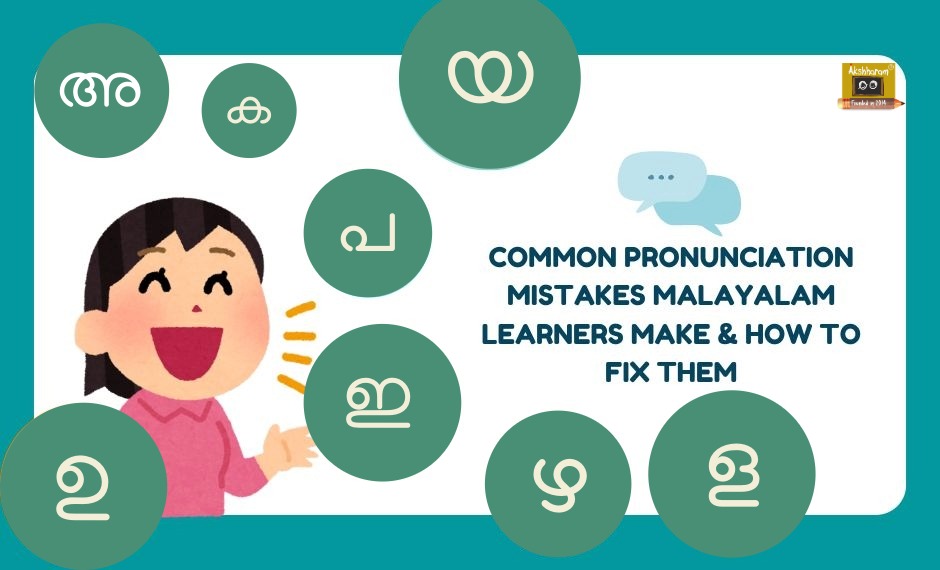
Malayalam is a language that truly stands for its cultural heritage and authenticity. It is not just a language, but an emotion for many of us. As Charlemagne widely quoted, to have another language is to possess a second soul. In Malayalam, every word has a rhythm and a poetic feel. A language becomes even more beautiful when it is perceived correctly, which means it can be listened to and appreciated properly. For that, it must be presented in its most beautiful form.
Unlike other languages, Malayalam always stands out with its rich sounds, curvilinear letters, expressive tone, and a flowing rhythm. From a literary perspective, Malayalam has a specific tone and style. But when it comes down to the Keralites, since Kerala has 14 districts, each one has its own special dialect, making the way of speaking different in each region.
We have been talking about the beauty of the Malayalam language. When it comes to Malayali children growing up abroad or non-native speakers, getting the pronunciation right can be a real challenge. Some letters roll off the tongue, while others require soft or deep sounds that aren’t easy to copy at first. For kids who mostly speak English at home, it can take time to get used to these differences.
Every day is a chance to learn new things. In the case of Malayalam, it starts at home, and the basics can be practiced through casual conversations around the table, during dinner, or even at bedtime with a bedtime story.
We have all heard that a perfectionist was once a beginner. After all, practice makes a man perfect. There can be common pronunciation mistakes that new, budding Malayalam learners make. Let's dive deep into the blog. What are those common mistakes, and how can we fix them?
Why is Malayalam pronunciation risky?
Some Malayalam letters require you to curl and roll your tongue backwards, while others are nasal sounds that resonate from the nose. There are also long and short vowel sounds that change both the length and the meaning of a word.
For many learners, especially those used to speak English, these sounds can feel unfamiliar. For example, English speakers often find it hard to pronounce letters like “ഴ” (zha) or “ണ” (ṇa) because these sounds don’t exist in English.
What are the common Malayalam mistakes that come with pronunciation?
1. Confusing similar sounds
Malayalam has alphabets that are relatively similar in pronunciation, which can be easily confused.
- For "ള" (ḷa) vs "ല" (la):
Touch your tongue-tip to the roof of your mouth for "ḷa," like the "l" in "full." For "la," the tongue-tip touches your upper teeth.
- For "റ" (ṟa) vs "ര" (ra):
Flick your tongue sharply for the hard "ṟa." For the soft "ra," simply tap the roof of your mouth once.
2. Mispronouncing retroflex sounds
In the Malayalam alphabet, there are some consonants that sound similar, making it difficult to notice the difference for beginners. For example, letters like “ട, ണ, ഡ, ള” require the tongue to curl back noticeably.
3. Ignore long and short vowels
Holding the vowel sound longer in "Kutti" (child) changes the word's meaning to "Kuṭṭi" (which can mean small, cute, or a punch), showing just how crucial vowel length is.
4. Skipping the nasal sounds
Malayalam has strong nasal consonants like ങ, ഞ, ണ, ന, and മ. When practicing, learners often tend to omit or flatten them.
5. Skipping the tone and rhythm
To compare English and Malayalam, the former has got has strong syllables and strong beats, to pronounce effectively with phonetics but allowing for distinct pronunciation. In the case of Malayalam, however, it is more like a flow of rhythm, so placing a heavy stress on the wrong syllable can make a word sound unnatural.
A Quick Guide to Fixing Common Pronunciation Mistakes?
Fixing pronunciation is mostly about listening, repeating, and getting small and steady practice, which can gradually make a difference.
Listen and imitate: It is very practical to practice listening and spend time hearing native Malayalam. For example, to become familiar with Malayalam, try playing music, stories, or podcasts. If they are old enough to enjoy movies, Malayalam films are a great example for listening to the way people speak and their dialogue delivery.
To reduce mistakes, focus on the sounds: how the speaker moves their mouth, where they place stress, and how long they hold vowels. Then, say the same lines aloud, copying the rhythm and flow.
Practice with native speakers: When it comes to helping children with pronunciation mistakes, the most effective and convenient tip is to practice with native speakers. For a child, their parents and other family members at home are the best people to practice with.
Record clippings: Try recording a short voice or video clip of the kids speaking. Listening back to it can help you easily identify areas where their pronunciation can be improved.
Focus on one sound at a time. Pick a tricky letter (for example “ഴ”) and practice words that contain it. Repeat the sound in isolation, then in syllables, then in short words. Ten minutes a day on one sound beats a long, unfocused session.
Use phonetic sounds: In Malayalam, there are vowels, chillakshanghal, and chinnaghal, which can make a word short or lengthy depending on the vowel and phonetic aids. Using these sounds helps train the tongue effectively.
Get feedback: Learning should feel freeing, especially for kids. Rather than criticizing and over-correcting, give them space to make mistakes. However, it's important to ensure they don't learn the wrong pronunciation. It should be corrected early on, so that a single word or a tiny change can make a huge difference, while they are still able to catch up quickly.
So far, we have been discussing the common pronunciation mistakes that occur while learning Malayalam. Apart from learning through conversation, let's take a look at Akshharam, a platform for Malayalam language communication class online. It provides a detailed and structured learning pattern to boost your confidence and knowledge in Malayalam.
Let’s enroll in the Beginner Malayalam learning class online today. Visit our website for more details.