
Malayalam Story Time Challenges: Weekly Story Goals for Kids
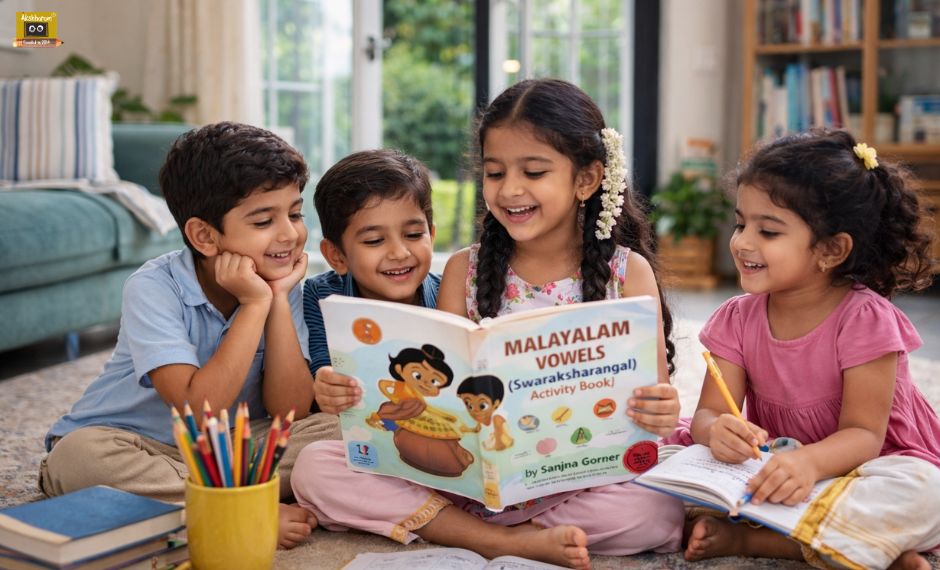
As a parent living outside Kerala, the struggle is real when you want your child to speak Malayalam with the same confidence they speak other languages. Maybe on your next vacation, you want your kids to laugh at the jokes everyone is cracking, or you want them to understand the meaning of that famous Malayalam song.
There are many ways to pass on the Malayalam language. One of the most effective ways to preserve the language is through the LSWR technique, which is Listening, Speaking, Reading, and Writing. This isn't about academics or curriculum; it's about how a young brain naturally acquires language. In a country where English or other languages dominate, it's understandable that Malayalam may take a backseat. As parents, we can counter this by creating opportunities for our children to hear Malayalam more often. Let's explore how storytelling can unlock the language in ways that go beyond words and letters.
What are the benefits of learning Malayalam through stories?
-
Phonetic Awareness
The Malayalam alphabet has some unique letters such as 'ഴ' (zha), 'റ' (ra), and 'ങ' (nga), which do not exist in English. If children are not used to these sounds, it will definitely be hard for them to pronounce them later. Once they are exposed to these sounds in daily conversation or during bedtime stories, it becomes easier for them.
-
Vocabulary Retention
One of the biggest challenges for a kid is memorizing words. Incorporating storytelling can significantly enhance their Malayalam vocabulary. On the other hand, the human brain is inclined towards stories, which can create meaningful connections and imaginary scenes.
-
Grammar
Stories serve as a powerful medium to teach grammar to young minds effectively. In a way, stories help build natural sentences with grammar intuitively absorbed, without confusion. This approach feels much easier than compelling children to follow particular grammar rules.
They learn that "ഞാൻ നാളെ വരും" (I will come tomorrow) sounds right, while "ഞാൻ നാളെ വന്നു" (I came tomorrow) sounds wrong, without ever having to memorize a conjugation table.
-
Confidence Building
Many children have a fear of making mistakes and anxiety about being judged or compared. These tiny little brains are scared of such external pressures. Stories naturally help foster more confidence in speaking Malayalam.
When children engage with captivating stories, such as those featuring adventurous characters, they become immersed in the narrative rather than focusing on the language itself. This immersive experience allows them to enjoy the moment and facilitates a more relaxed mental state, thereby lowering their affective filter and increasing their openness to absorbing the language.
-
Emotional Connection
Malayalam is not just a language, but an emotion that blends idioms, proverbs, and culture that don't translate easily.
What is the weekly Story Time Method?
Story Time isn't just about reading a book aloud. It is an interactive process:
Level 1: We use stories to hunt for sounds and letters.
Level 2: We use stories to build vocabulary banks.
Level 3: We use stories to inspire original writing and complex conversations.
How can Malayalam be taught through story time?
A child cannot say a word that they cannot hear properly. Therefore, it is important to teach every letter with its sound. Learning a language doesn't mean memorizing each letter and word. To have a clear picture of the sounds, they first need to be registered in the mind. For that, stories are the best choice.
Level 1: Detecting Voices and Sounds
When narrating a story about a kakka(Crow) or kozhi (Hen), the storyteller can use flashcards. While narrating, imitate the sounds of the bird. This way, children will recognize the sounds, will be able to identify a crow and a hen whenever they see them, and will also be able to say "kaaka" and "kozhi." This automatically gets stored in their brain.
When a story is being told, there is a word at the beginning, but before the word, there is sound. At Akshharam, we focus on a fundamental pattern that believes in phonetics. It's not that kids first learn sounds, then words, then writing—no. At Akshharam, they learn in a sequence that matches the caliber and capacity of the child.
They aren't just listening to a story; they are actively deconstructing the language. By the end of the session, they transition from listening to doing to writing the letter with Malayalam language writing class online.
Level 2: Word Building Challenge
Another way stories can build vocabulary is by telling the first sentences of the story, then letting the child say the rest. This approach helps kids improve their imagination and also creates new endings.
Level 3: "Story Cubes" challenge
The child is presented with three random images—for example, a school, a friend, and a banana. Their mission is to weave these three unrelated items into a coherent, logical story with a beginning, middle, and end.
But there is a twist! They must also incorporate the "Grammar Goal of the Week," such as using the past tense correctly or including a dialogue between two characters. This does more than just teach language; it teaches thinking in Malayalam. It requires the child to construct meaningful phrases and communicate complex ideas.
What makes our Malayalam language communication class online different is that we don't just focus on output; we focus on the process. Akshharam is holistic and structured into four progressive levels, focusing initially on foundational skills before advancing to more complex language constructs.
Overall, the approach combines direct instruction of letters and sounds with contextual and practical applications of language, ensuring a comprehensive understanding of language mechanics as students move through each level and session.
Whether your child is just starting with letters or constructing complex sentences, our live tutors and customized lesson plans ensure they are always engaged, challenged, and most importantly, having fun.
Are you ready to hear your child tell you a story in Malayalam?
Join Akshharam today and let the storytelling begin.